Key points
- Book ‘Timeless India: Protection & Revival of Indian Cultural Identity under the Leadership of Prime Minister Narendra Modi’ launched in collaboration with IGNCA and ASI
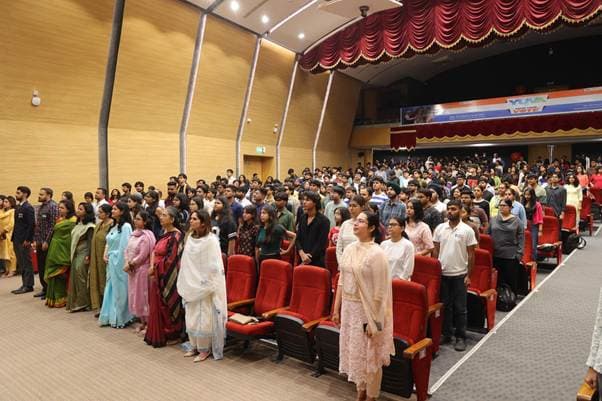
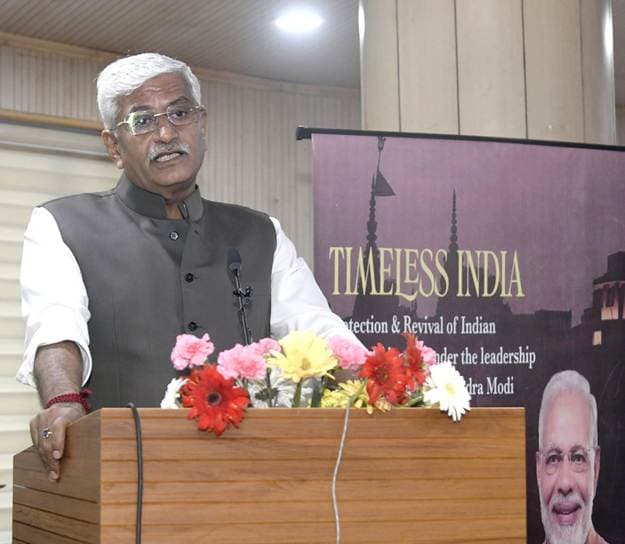
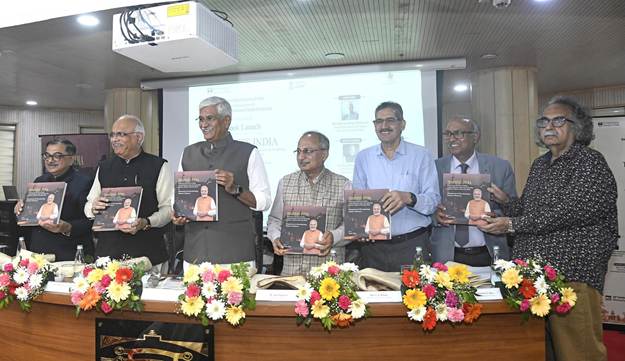
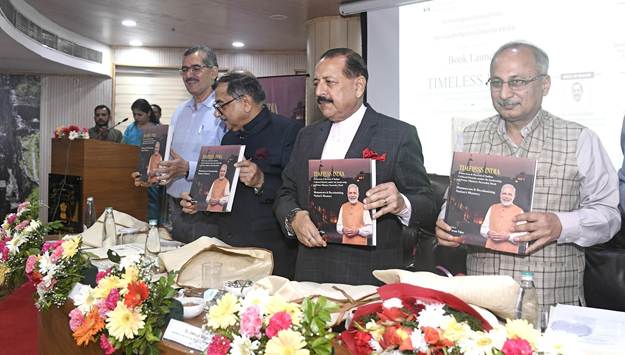
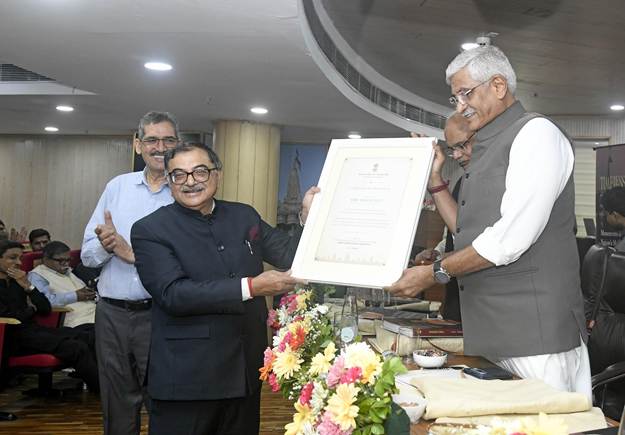
Highlighting the preservation of India’s cultural identity, the revival of monuments and the discourse on the nation’s historical memory, the book Timeless India: Protection & Revival of Indian Cultural Identity under the Leadership of Prime Minister Narendra Modi was launched on today through a collaboration between the Archaeological Survey of India (ASI) and the Indira Gandhi National Centre for the Arts (IGNCA). The book has been published by IGNCA and Subhi Publications and edited by Tarun Vijay. The event was held at Dharohar Bhawan, ASI, Mandi House, New Delhi, with Union Minister for Culture and Tourism Shri Gajendra Singh Shekhawat as the Chief Guest. Dr. Jitendra Singh, Minister of State for Science and Technology and Earth Sciences, attended as the Guest of Honour. Dr. Vinay Sahasrabuddhe, former Rajya Sabha Member and former President of the Indian Council for Cultural Relations (ICCR), delivered the keynote address. The session was chaired by cultural thinker Dr. Anil Goyal.
The welcome address was delivered by Shri Y. S. Rawat, Director General, Archaeological Survey of India. The inaugural address was delivered by Prof. (Dr.) Ramesh C. Gaur, Dean, School of Arts, Media and Design, South Asian University. Shri Tarun Vijay, author and editor of the book, noted journalist and former Rajya Sabha Member, spoke about the book’s content and objectives. The vote of thanks was delivered by Prof. K. Anil Kumar, Head of the Kala Nidhi Division, IGNCA.
Union Minister for Culture and Tourism Shri Gajendra Singh Shekhawat said that India is not merely an entity confined within geographical boundaries, but a cultural nation shaped by thousands of years of continuity, knowledge, spiritual practice, struggle and experience. India’s civilisation and cultural consciousness have flowed uninterrupted through the centuries. India has established connections with civilisations across the world through dialogue and cultural exchange. Its knowledge traditions, architectural heritage and cultural legacy have attracted countries across the world.
He said that during colonial rule, efforts were made to weaken Indians’ sense of pride in their civilisation, culture and traditions. This also influenced the way Indians viewed their own knowledge traditions and cultural ideals. The distinctive feature of Indian civilisation is its ability to draw inspiration from the past while moving towards the future. Ideals represented by Lord Rama and Lord Krishna, along with the traditions of sages, thinkers and seekers of knowledge, remain important foundations of India’s cultural consciousness.
Dr. Jitendra Singh appreciated the book and commended its editor, cultural thinker, author and senior journalist Shri Tarun Vijay, for bringing out a significant publication that highlights the importance of preserving and revitalising India’s cultural identity.
Dr. Vinay Sahasrabuddhe said that understanding India’s ancient culture and its timeless journey requires an awareness of, and pride in, its cultural heritage. He observed that, for a long time after Independence, there had been an unnecessary hesitation in speaking openly about Indian culture, making it difficult to break completely free from the colonial mindset. Books such as Timeless India provide an opportunity to understand India’s cultural continuity and the essence of Indianness.
Referring to Mark Tully’s book No Full Stops in India, he drew attention to a distinctive characteristic of the Indian mind. He said that the Indian mind does not seek to undermine the faith of ordinary people, but rather to understand their beliefs and lived experiences. The journey of Indian civilisation has been one of continuity, dialogue and change, and cannot be confined to a single conclusion or a limited perspective.
He emphasised that alongside publishing and preserving books, it is equally important to encourage the habit of reading. Indian culture should not remain confined to books but should become part of education and everyday life. He stressed the need to promote education in the mother tongue and to bring content related to Indian life and culture to students. He added that understanding India’s timeless cultural journey from an appropriate perspective and freeing the education system from colonial influences are important needs of the present time.
Dr. Anil Goyal while delivering his chair remarks said that India is an ancient civilisation and a cultural consciousness shaped by a living tradition that has flowed for thousands of years. Despite numerous invasions and changes, India’s cultural spirit remains alive. Its temples, stupas, forts, sculptures and inscriptions are not merely historical monuments, but testimonies to the knowledge, art, science, faith and philosophy of its ancestors. He said that preserving heritage is a responsibility towards national identity, cultural continuity and future generations.
He emphasised the need to understand Indian history through facts and evidence and to bring forgotten achievements to light. Stressing the importance of understanding cultural heritage free from colonial influences, he said that a country should be assessed through parameters that reflect its social and cultural realities. Development and heritage, modernity and tradition, and science and culture are not contradictory but complementary. Books such as Timeless India play an important role in broadening understanding of India’s civilisational continuity and cultural heritage.
On the occasion, scholars, historians and intellectuals highlighted the importance of India’s civilisational continuity, cultural heritage and the preservation of its historical legacy through Timeless India.
A Book Focused on Monument Preservation and Cultural Memory
Timeless India explores the role of monuments in preserving and revitalising India’s cultural identity, alongside the discourse surrounding the nation’s historical memory. The title points to India’s cultural continuity, which remains evident through different historical periods, architectural traditions and forms of cultural heritage.
The book gives particular importance to monument preservation and the idea of “decolonising the nation’s memory”. This perspective highlights the need to understand India’s cultural heritage through its own historical experiences, traditions and cultural outlook.
The launch presented the publication as an important initiative towards preserving Indian cultural heritage and broadening the discourse around it. The event also provided an opportunity to advance dialogue on culture, history, archaeology and cultural studies.
***
M Annadurai
Photos
This report is based on the official release by the Ministry of Culture, issued through the Press Information Bureau, Government of India (28 OCT 2026 8:55PM by PIB Delhi). Read the original: India’s Cultural Consciousness and Knowledge Traditions Form the Foundation of Its Civilisational Continuity: Shri Gajendra Singh Shekhawat.
How we verified this
VerifiedEvery fact, figure and quotation is taken from the official PIB release (Release ID 2329786) issued by the Ministry of Culture on 28 OCT 2026 8:55PM by PIB Delhi; checked against the source on 28 Oct 2026. Headline and summary written by BDT from that release.
Sources
- 1.India’s Cultural Consciousness and Knowledge Traditions Form the Foundation of Its Civilisational Continuity: Shri Gajendra Singh Shekhawat — Press Information Bureau, Government of India