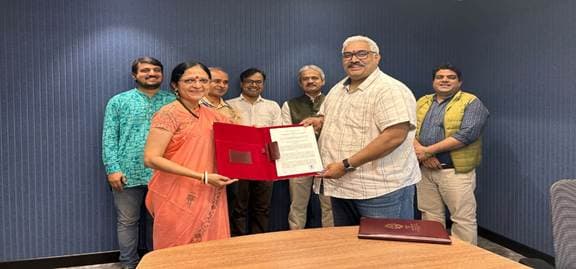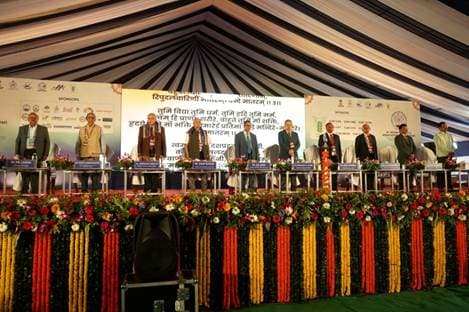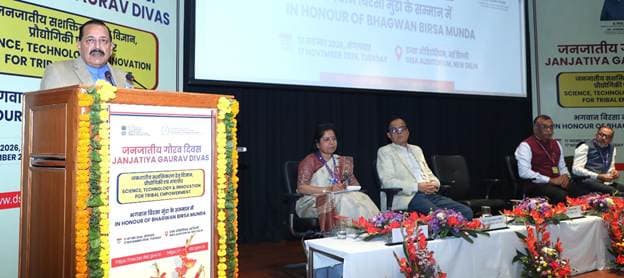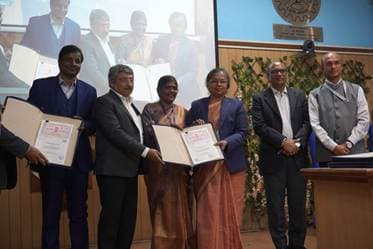
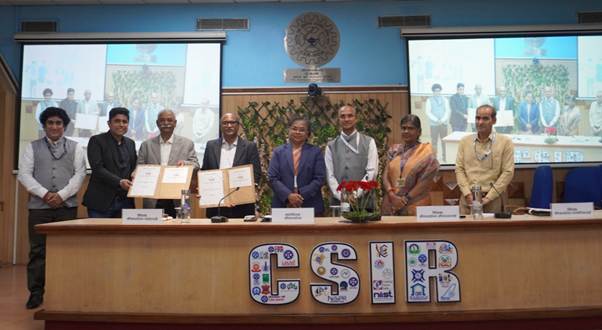
The Council of Scientific and Industrial Research (CSIR) has handed several of its laboratory technologies to industry partners, including a road material made partly from rice straw, as part of its monthly technology-transfer event at its New Delhi headquarters.
The session was chaired by Dr N. Kalaiselvi, Director General of CSIR and Secretary of the Department of Scientific and Industrial Research. It featured work from four labs: the Structural Engineering Research Centre (SERC) in Chennai, the Central Road Research Institute (CRRI) in New Delhi, the Advanced Materials and Processes Research Institute (AMPRI) in Bhopal and the Indian Institute of Petroleum (IIP) in Dehradun.
Technologies transferred
- Emergency Retrieval System for power lines (SERC): a lightweight, modular structure for quickly restoring transmission lines after failures. It went to IFAB Global.
- Recycled-aggregate bricks, hollow blocks and paver blocks (SERC): made with 100 per cent recycled aggregates and industrial waste. Transferred to the National Automotive Test Tracks (NATRAX).
- Ultra-High-Performance Concrete pavement (SERC): a strong, durable pavement material meant for heavy axle loads and lower maintenance, transferred to NATRAX for pilot-scale field use.
- MicroReAct-RAP™ (CRRI): a cold micro-surfacing method using up to 40 per cent reclaimed asphalt pavement. Three firms received it: Innovative Roadztech (Delhi), AVK BlackGold Infra (Surat) and Hindustan Colas (Mumbai).
- Bio-Bitumen (CRRI with IIP): converts agricultural residues, including rice straw (parali), into a material that can partly replace petroleum-based bitumen. It went to RAACS Solutions (Bihar, BioBhoomi) and SAR Parivahan (Kolkata).
Two MoUs
CRRI also signed two memoranda of understanding. One is with the Global Automotive Research Centre in Tamil Nadu for joint R&D, shared testing facilities and academic exchanges. The other is with Pārakhi Skill Systems, Patna, for research on driver risk assessment and related field trials.
Why it matters
Kalaiselvi said it is “imperative” for CSIR to transfer more technologies to industry so that lab research turns into economic and social benefits. She said the true measure of research lies in products, processes and technologies that benefit industry and society.
The release gives no commercial terms or deployment dates for the transfers.
Photos
Source: official release by the Ministry of Science & Technology, issued through the Press Information Bureau, Government of India (19 NOV 2026 11:08AM by PIB Delhi). Read the full official text: Council of Scientific and Industrial Research Transfers Indigenous Technologies to Industry to Accelerate Commercialisation and Promote Sustainable Development.
How we verified this
VerifiedEvery fact, figure and quotation is taken from the official PIB release (Release ID 2338251) issued by the Ministry of Science & Technology on 19 NOV 2026 11:08AM by PIB Delhi; checked against the source on publication. Story written by BDT from that release; no outside facts added.
Sources
- 1.Council of Scientific and Industrial Research Transfers Indigenous Technologies to Industry to Accelerate Commercialisation and Promote Sustainable Development — Press Information Bureau, Government of India