ExplainersExplainerVerified
Explained: how the ₹10,000-crore container manufacturing scheme works
Why India imports almost all its containers today, and what the new scheme will change.
Key points
- India’s ₹10,000-Crore Catalyst for Container Manufacturing
Container Manufacturing Promotion Scheme
Maritime transport is a cornerstone of global trade, with shipping containers playing a vital role in the seamless movement of goods across borders. As of February 2026, India’s maritime sector facilitated 95% of the country’s trade by volume and 70% by value. Beyond its role in trade, the sector contributes 4-5% to India’s GDP.
As India strengthens its position in global manufacturing and international commerce, the demand for containerised cargo movement continues to grow, underscoring the need to build domestic container manufacturing capabilities. To amplify this, the Union Cabinet has approved the Container Manufacturing Promotion Scheme (CMPS) with budgetary outlay of ₹10,000 crore up to FY 2039-40.
What are Containers?
Shipping containers are standardized steel freight containers that transport cargo across ships, railways and road vehicles without unloading and repacking the goods during transit. Built as per ISO (International Organization for Standardization) specifications, they enable seamless intermodal transport and efficient global trade. The most common sizes are 20-foot and 40-foot containers, measured in Twenty-foot Equivalent Units (TEUs), the standard unit used to measure container capacity.
Building India’s Container Manufacturing Ecosystem
CMPS supports the Government's initiatives under Make in India, Maritime Amrit Kaal Vision 2047 and multimodal logistics development, contributing to India's long-term maritime and trade ambitions-
DID YOU KNOW?
As per the United Nations Conference on Trade and Development (UNCTAD), ~80% of global merchandise trade by volume is transported by sea.
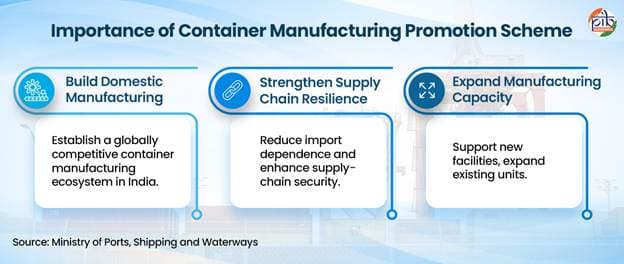
- It aims to establish a globally competitive container manufacturing ecosystem by promoting domestic manufacturing and encouraging investment across the value chain.
- The initiative seeks to reduce import dependence and strengthen supply-chain resilience.
- It also supports new manufacturing facilities and expands existing container manufacturing units.
Components under CMPS
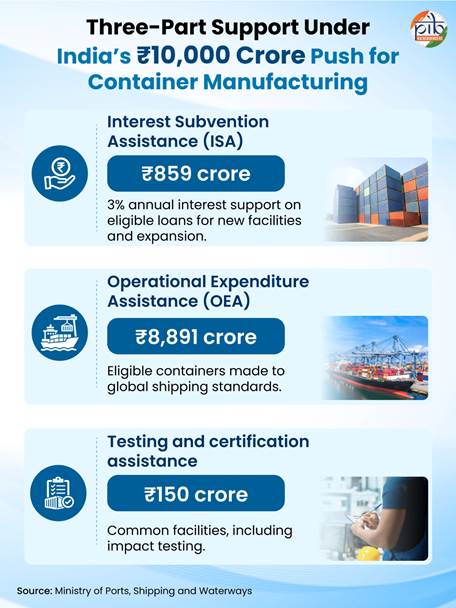
The scheme provides assistance through major components: investment support, operational expenditure, and testing and certification.
Interest Subvention Assistance (ISA)
With a financial outlay of ₹859 crore, ISA provides a 3% per annum interest subvention on eligible term loans (capital loans) availed by container manufacturers to set up greenfield facilities and brownfield expansion of existing manufacturing capacity. To qualify for this support, projects must meet the following criteria:
Greenfield and Brownfield Facilities
A greenfield project involves building a completely new asset, while a brownfield project involves upgrading, renovating, or repurposing an existing asset.
- Greenfield facilities must have an annual capacity of at least 1,00,000 TEUs;
- Brownfield expansions must add at least 25,000 TEUs of annual capacity to be commissioned within three years of in-principle approval, and comply with global container standards.
Operational Expenditure Assistance (OEA)
The component provides a financial outlay of ₹8,891 crore to support containers manufactured as per global shipping standards and sold by eligible manufacturers. The assistance is intended to bridge the cost gap and improve the competitiveness of domestically manufactured containers.
| Operational Expenditure Assistance (OEA) by Container Type | |
|---|---|
| Container Type | Assistance Value (per container) |
| 20 ft Container | ₹49,500 |
| 40 ft Container | ₹86,625 |
| 20 ft Specialised Container | ₹37,125-₹74,250 |
To avail support, manufacturers must meet a minimum local-content requirement of 70% through FY 2031-32. These criteria will further rise to 90% from FY 2032-33 to strengthen the domestic supply chain.
Testing and certification assistance
A financial outlay of ₹150 crore has been allocated to support the setting up of common facilities such as Dynamic longitudinal impact.
Expected Outcomes and Wider Economic Impact
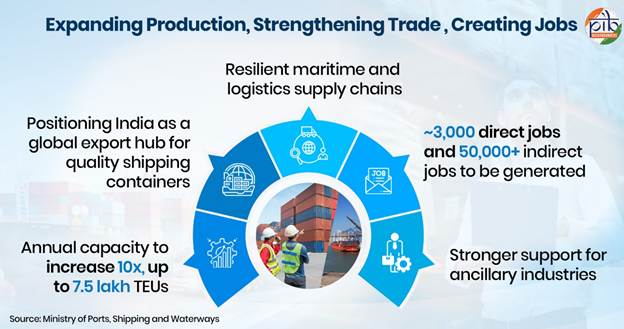
The scheme aims to expand domestic container production while strengthening India’s export potential, supply chains and related industries.
- Expanded manufacturing capacity: Annual domestic container manufacturing capacity is expected to increase by around ten-fold, up to 7.5 lakh TEUs.
- Export potential: It will help build a globally competitive container manufacturing base and help India strengthen its potential to position itself as a global export hub for quality shipping containers.
- Supply-chain resilience: The resilience of India’s maritime and logistics supply chains is expected to strengthen.
- Employment generation: It aims to generate an estimated 3,000 direct jobs and over 50,000 indirect jobs.
- Support for ancillary industries: The Scheme is also expected to benefit industries such as corner castings, specialised steel, wooden frames and paints.
Strengthening India’s Maritime Ecosystem
In addition to CMPS, various other measures have been undertaken to build an integrated, domestically anchored logistics ecosystem.
Establishment of the Bharat Container Shipping Line (BCSL)
To build and support an integrated container ecosystem anchored in India, a Memorandum of Understanding (MoU) was signed in February 2026 to establish the Bharat Container Shipping Line (BCSL).
The agreement brings together the Shipping Corporation of India (SCI), Container Corporation of India (CONCOR), Jawaharlal Nehru Port Authority (JNPA), V.O. Chidambaranar Port Authority (VOCPA), Chennai Port Authority and Sagarmala Finance Corporation Limited (SMFCL), under the aegis of the Ministry of Ports, Shipping and Waterways.
The MoU will establish a self-reliant container shipping ecosystem linking JNPA, VOCPA and Chennai ports with inland markets. It aims to improve end-to-end logistics, stabilise freight costs and strengthen India’s trade competitiveness.
Broader Support for the Maritime Sector
Several complementary government initiatives are also strengthening India’s maritime sector.
| Area of Support | Key Measures and Initiatives |
|---|---|
| Legislative Support | Merchant Shipping Act, 2025, the Coastal Shipping Act, 2025 and the Indian Ports Act, 2025 |
| Digital Support for Ease of Doing Business | One Nation One Port Process (ONOP), the Maritime Single Window and e-Samudra |
| Integrated Logistics Network | PM Gati Shakti, The National Logistics Policy (NLP), The Sagarmala Programme |
Conclusion
CMPS is set to strengthen India’s maritime manufacturing capabilities, enhance supply-chain resilience and create employment opportunities, while reducing import dependence. Aligned with broader maritime reforms, the scheme advances India’s ambition to emerge as a globally competitive maritime manufacturing and logistics hub.
References
Ministry of Ports, Shipping and Waterways
https://sansad.in/getFile/annex/270/AU2875_nAmH3t.pdf?source=pqars&utm
https://www.pib.gov.in/PressReleasePage.aspx?PRID=2221817®=48&lang=2
https://dgma.gov.in/download/1775649151_69d6417f46b3f_dgs-nmdc-address-01042026.pdf?utm
https://www.pib.gov.in/PressReleasePage.aspx?PRID=2222805&lang=1®=3&utm
https://www.pib.gov.in/PressReleasePage.aspx?PRID=2280831&lang=1®=3&utm
https://www.pib.gov.in/PressReleaseIframePage.aspx?PRID=2222805&lang=2®=3
https://shipmin.gov.in/sites/default/files/Monthly%20Summary%20-%20Feburary%2C%202026.pdf
**United Nations Conference on Trade and Development (**UNCTAD)
https://unctad.org/topic/transport-and-trade-logistics/review-of-maritime-transport
https://unctad.org/publication/review-maritime-transport-2025
https://unctad.org/news/shipping-data-unctad-releases-new-seaborne-trade-statistics
Organisation for Economic Co-operation and Development (OECD)
https://survey.oecd.org/index.php?lang=en&r=survey%2Findex&sid=744293
PIB Archives
https://www.pib.gov.in/PressReleasePage.aspx?PRID=2297455®=48&lang=1
PIB Research
Photos
This report is based on the official release by the PIB Backgrounder, issued through the Press Information Bureau, Government of India (28 OCT 2026 5:28PM by PIB Delhi). Read the original: Container Manufacturing Promotion Scheme.
How we verified this
VerifiedEvery fact, figure and quotation is taken from the official PIB release (Release ID 2329601) issued by the PIB Backgrounder on 28 OCT 2026 5:28PM by PIB Delhi; checked against the source on 28 Oct 2026. Headline and summary written by BDT from that release.
Sources
- 1.Container Manufacturing Promotion Scheme — Press Information Bureau, Government of India