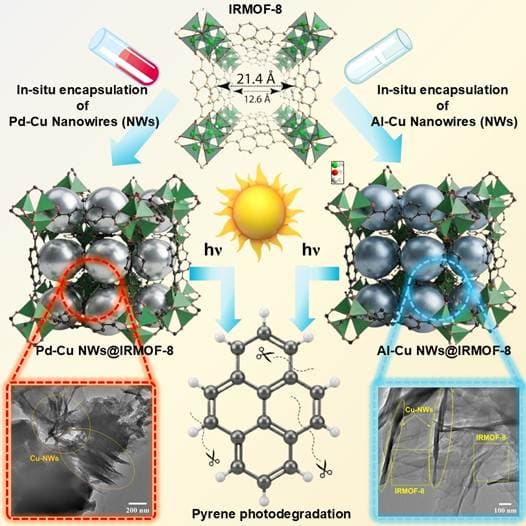
Scientists in Guwahati have built a new light-driven material that removed up to 99% of a persistent, toxic pollutant called pyrene in lab tests, the Department of Science and Technology said on 23 November.
Pyrene is a polycyclic aromatic hydrocarbon (PAH). It is toxic to living organisms and hard to clean up. The Institute of Advanced Study in Science and Technology (IASST), Guwahati, developed the material by placing copper nanowires inside a metal-organic framework (MOF) called IRMOF-8, and adding palladium or aluminium nanostructures to boost light absorption.
The results
- The palladium version removed 99% of pyrene under the test conditions of light plus ultrasonication.
- The aluminium version removed 85%.
Aluminium is cheaper and more abundant than palladium. The lead researcher, Prof. Devasish Chowdhury, said the aluminium system shows strong performance and could reduce reliance on noble metals.
The material works on visible and near-infrared light. The team says the approach could help clean water bodies and aquatic ecosystems. The study, with PhD scholar Netra Prova Baruah and colleagues, was published in ACS Applied Energy Materials. The release reports laboratory results only, not field trials.
Source: official release by the Ministry of Science & Technology, issued through the Press Information Bureau, Government of India (23 NOV 2026 3:49PM by PIB Delhi). Read the full official text: New advanced material developed by incorporating metallic nanowires into MOFs can harness sunlight to degrade pollutants.
How we verified this
VerifiedEvery fact, figure and quotation is taken from the official PIB release (Release ID 2340334) issued by the Ministry of Science & Technology on 23 NOV 2026 3:49PM by PIB Delhi; checked against the source on publication. Story written by BDT from that release; no outside facts added.
Sources
- 1.New advanced material developed by incorporating metallic nanowires into MOFs can harness sunlight to degrade pollutants — Press Information Bureau, Government of India