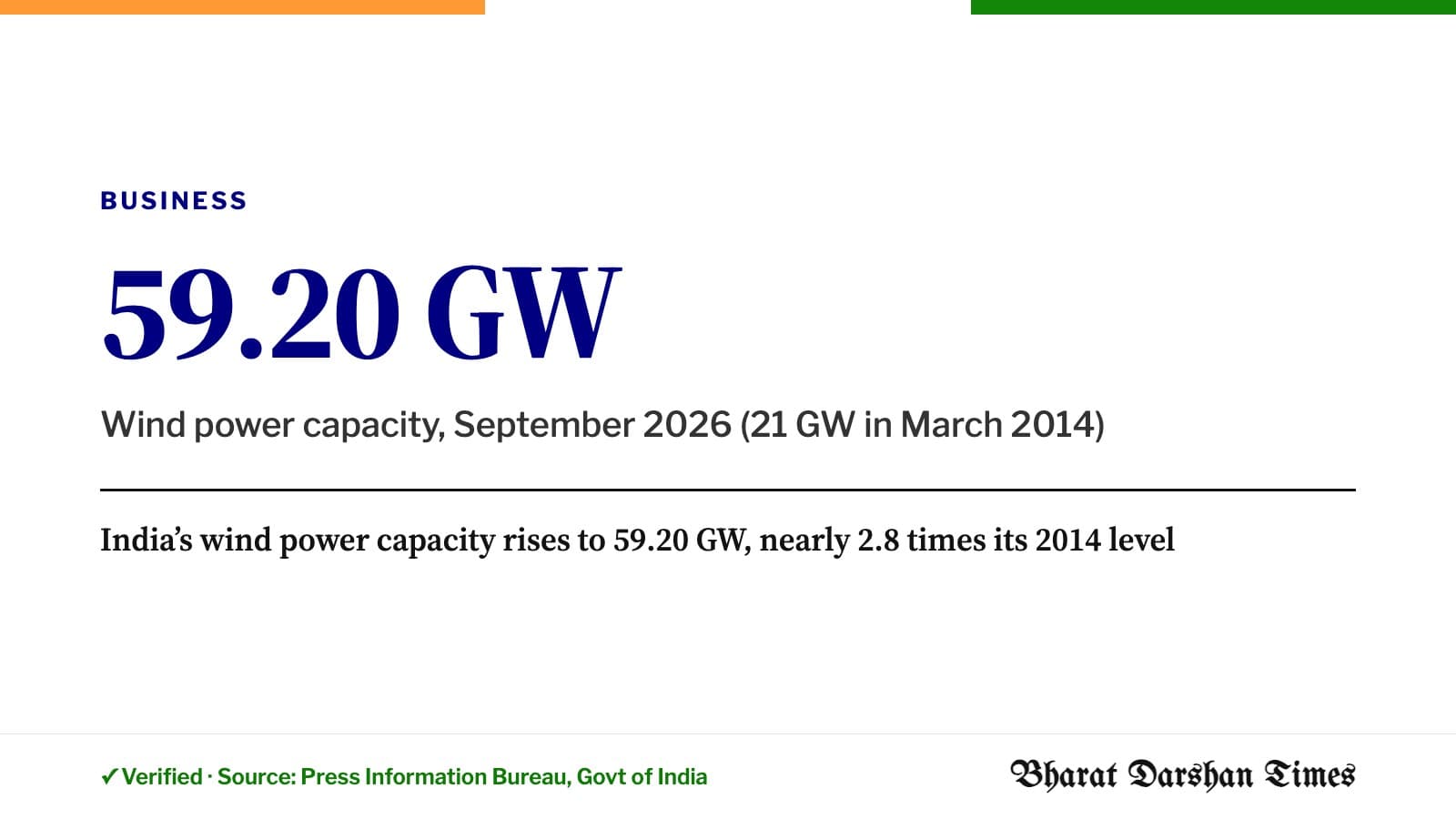
India's wind power capacity has grown from 21 gigawatts (GW) in March 2014 to 59.20 GW in September 2026, nearly 2.8 times as much, according to a PIB backgrounder on the country's wind energy transition.
Wind now makes up about 19.8% of India's total installed renewable energy capacity of 299.25 GW as of 30 September 2026. India ranks fourth in the world in installed wind capacity, and a further 28 GW is under implementation.
The numbers
- Record year: India added 6.05 GW of wind capacity in 2025-26, its highest in a year, surpassing the earlier record of 5.4 GW in 2016-17.
- Generation: wind farms produced 106.7 billion units of electricity in 2025-26.
- Peak hours: nearly 45% of wind generation happens during peak demand hours, which complements solar power and helps grid reliability, the backgrounder says.
- Manufacturing: turbine manufacturing capacity has risen from 10 GW in 2014 to about 24 GW as of March 2026, with 70–80% indigenisation across key components.
Where the wind is
India's estimated gross wind potential is 695.5 GW at 120 metres and 1,163.9 GW at 150 metres above ground. At 150 metres, most of it lies in eight states: Rajasthan (284.2 GW), Gujarat (180.8 GW), Maharashtra (173.9 GW), Karnataka (169.3 GW), Andhra Pradesh (123.3 GW), Tamil Nadu (95.1 GW), Madhya Pradesh (55.4 GW) and Telangana (54.7 GW). More than 900 monitoring stations set up by the National Institute of Wind Energy map the resource.
What the government has done
- ₹6,853 crore of Viability Gap Funding has been approved for 1,000 MW of offshore wind, 500 MW each off Gujarat and Tamil Nadu.
- A 500 MW pilot has been launched under Contracts for Difference, a mechanism meant to reduce price volatility and give developers revenue certainty.
- A Task Force formed in January 2026 is looking at regulatory, land, transmission and implementation challenges.
- Other measures include a wind component in Renewable Purchase Obligations, Green Energy Open Access Rules, the Approved List of Models and Manufacturers, and promotion of hybrid and round-the-clock renewable projects.
What happens next
The backgrounder lists targets of 100 GW of wind capacity by 2030 and 156 GW by 2036. Priorities include expanding into Madhya Pradesh, Telangana and Odisha, opening offshore wind leasing areas in Gujarat and Tamil Nadu, pairing wind with storage, and using artificial intelligence-based forecasting tools to modernise the grid.
Source: official release by the PIB Backgrounder, issued through the Press Information Bureau, Government of India (18 NOV 2026 11:00AM by PIB Delhi). Read the full official text: India's Wind Energy Transition.
How we verified this
VerifiedEvery fact, figure and quotation is taken from the official PIB release (Release ID 2337735) issued by the PIB Backgrounder on 18 NOV 2026 11:00AM by PIB Delhi; checked against the source on publication. Story written by BDT from that release; no outside facts added.
Sources
- 1.India's Wind Energy Transition — Press Information Bureau, Government of India