India vs WorldVerified
Aditya-L1 shows a solar eruption expanded unevenly, not as a symmetric bubble
Scientists at the Indian Institute of Astrophysics combined data from the VELC instrument with NASA’s SDO; the finding matters for space-weather studies.
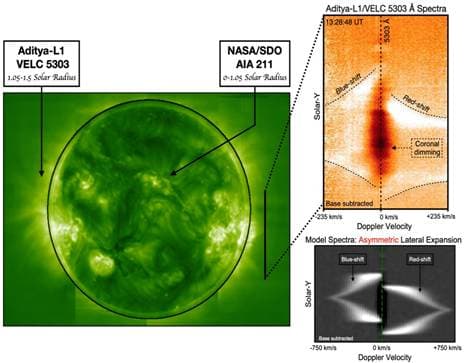
Data from India's Aditya-L1 solar observatory have shown that a coronal mass eruption does not expand like a simple symmetric bubble, a finding that could improve space-weather studies.
Scientists at the Indian Institute of Astrophysics, an autonomous institute of the Department of Science and Technology, combined observations from Aditya-L1's Visible Emission Line Coronagraph (VELC) with NASA's SDO spacecraft and three-dimensional modelling to reconstruct the eruption's full geometry. Their study, in Astrophysical Journal Letters, showed for the first time that the eruption underwent non-uniform expansion and developed an asymmetric shape.
Why it matters
Such differences can affect how fast an eruption travels towards Earth, and so the space-weather disturbances it can cause for satellites and communication networks.
The mission
Aditya-L1 was launched in September 2023 and operates at the Sun–Earth L1 point with seven payloads. VELC, the primary payload, is an internally occulted coronagraph that studies the solar corona, including through the 530.3 nm green emission line of highly ionised iron.
Source: official release by the Ministry of Science & Technology, issued through the Press Information Bureau, Government of India (03 NOV 2026 12:17PM by PIB Delhi). Read the full official text: VELC on board Aditya-L1 reveals asymmetric expansion of solar eruption that could impact space weather.
How we verified this
VerifiedEvery fact, figure and quotation is taken from the official PIB release (Release ID 2331935) issued by the Ministry of Science & Technology on 03 NOV 2026 12:17PM by PIB Delhi; checked against the source on publication. Story written by BDT from that release; no outside facts added.
Sources
- 1.VELC on board Aditya-L1 reveals asymmetric expansion of solar eruption that could impact space weather — Press Information Bureau, Government of India