ExplainersExplainerVerified
Explained: how rabi MSPs are set, and what wheat and mustard farmers will get in 2027-28
Wheat MSP rises ₹25 to ₹2,610 a quintal; the Centre expects to pay farmers ₹90,962 crore for 324 lakh tonnes.
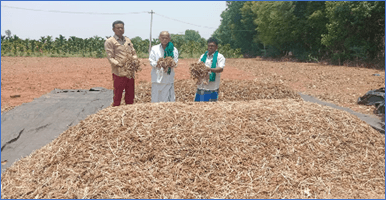
Wheat farmers will get a minimum support price (MSP) of ₹2,610 a quintal for the 2027-28 rabi season, ₹25 more than the current ₹2,585, and the Centre expects to pay out ₹90,962 crore for 324 lakh tonnes of produce.
The Government approved higher MSPs for all mandated rabi crops on 30 September 2026. This PIB backgrounder explains how the prices are decided and how farmers are paid.
The new prices
| RABI MARKETING SEASON 2027-28 | ||||||
|---|---|---|---|---|---|---|
| S.N. | Crops | MSP 2027-28 (₹/quintal) | Cost of Production 2027-28 (₹/quintal) | Margin Over Cost (%) | MSP 2026-27 (₹/quintal) | Increase in MSP (Absolute) |
| 1 | Wheat | 2,610 | 1,264 | 106 | 2,585 | 25 |
| 2 | Barley | 2,286 | 1,447 | 58 | 2,150 | 136 |
| 3 | Gram | 5,958 | 3,751 | 59 | 5,875 | 83 |
| 4 | Lentil (Masur) | 7,390 | 3,854 | 92 | 7,000 | 390 |
| 5 | Rapeseed & Mustard | 6,613 | 3,367 | 96 | 6,200 | 413 |
| 6 | Safflower | 7,215 | 4,810 | 50 | 6,540 | 675 |
The biggest rise in rupee terms is for safflower, up ₹675 a quintal, followed by rapeseed and mustard (₹413), lentil or masur (₹390) and barley (₹136). Wheat has the highest estimated margin over the cost of production at 106%, followed by rapeseed and mustard at 96%, lentil at 92% and gram at 59%. The release says the increases are intended to ensure remunerative prices and encourage crop diversification.
How an MSP is set
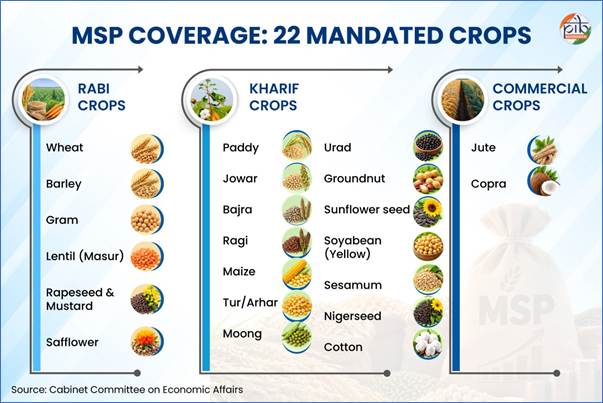
The Government announces MSPs each year for 22 mandated crops, based on recommendations from the Commission for Agricultural Costs and Prices (CACP) after consulting State Governments and central ministries. The CACP weighs the cost of production, demand and supply, domestic and international prices, price parity between crops, and the terms of trade between farming and other sectors. It also looks for a minimum margin of 50% over the cost of production, which includes the imputed value of family labour.
How the buying works
Cereals are bought through the Food Corporation of India (FCI) and State agencies. Pulses, oilseeds and copra are bought under the Price Support Scheme of PM-AASHA, run by NAFED and NCCF, when market prices fall below MSP.
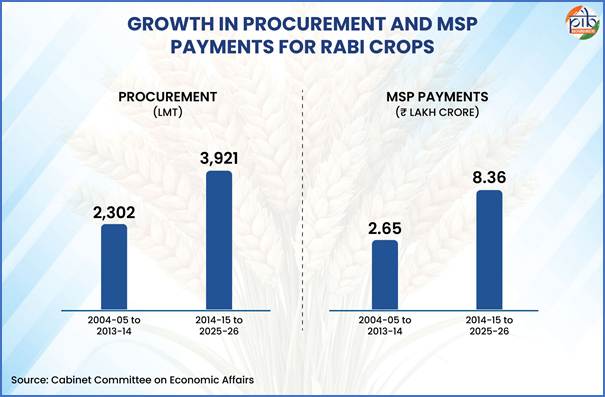
The release gives figures on the scale of support. Procurement of six rabi crops was 2,302 lakh tonnes between 2004-05 and 2013-14 and 3,921 lakh tonnes between 2014-15 and 2025-26. MSP payments rose over the same periods from ₹2.65 lakh crore to ₹8.36 lakh crore.
As of 19 October 2026, NCCF's e-Samyukti platform had handled procurement involving more than 43 lakh farmers, with over 37.45 lakh tonnes bought and more than ₹13,000 crore credited to farmers.
One farmer's story
The backgrounder cites K. Chikkana, a 72-year-old millet farmer from Bombrahalli, Karnataka. After switching to an improved finger millet variety, his yield rose from 9–11 to 22–23 quintals an acre, and with procurement at the 2025-26 MSP of ₹4,886 a quintal his income from six acres rose from about ₹2.07 lakh to ₹6.59 lakh.
Photos
Source: official release by the PIB Backgrounder, issued through the Press Information Bureau, Government of India (29 OCT 2026 11:06AM by PIB Delhi). Read the full official text: Minimum Support Price for Rabi: Marketing Season 2027-28.
How we verified this
VerifiedEvery fact, figure and quotation is taken from the official PIB release (Release ID 2329868) issued by the PIB Backgrounder on 29 OCT 2026 11:06AM by PIB Delhi; checked against the source on publication. Story written by BDT from that release; no outside facts added.
Sources
- 1.Minimum Support Price for Rabi: Marketing Season 2027-28 — Press Information Bureau, Government of India