ExplainersExplainerVerified
Explained: India’s chemicals and petrochemicals sector and the push to grow it
The sector is valued at about $220 billion; the government’s own backgrounder lays out the parks, funding and safety measures behind it.
India is the world's sixth-largest producer of chemicals, and the government wants a sector now valued at about $220 billion to reach $300 billion by 2030 and $1 trillion by 2040. A PIB backgrounder published on 7 November sets out how.
The sector supplies pharmaceuticals, textiles, construction, automobiles, electronics and consumer goods. India is also the second-largest manufacturer and exporter of dyes and the third-largest exporter of agrochemicals. It has about 13,000 large units and 4.45 lakh micro, small and medium enterprises.
Money and output
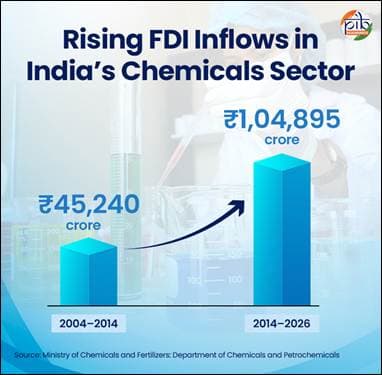
India allows 100% foreign direct investment through the automatic route in most chemical sectors. FDI inflows reached ₹1,04,895 crore over 2014–2026, against ₹45,240 crore in 2004–2014. Production of major chemicals and petrochemicals rose from 45,638 thousand tonnes in 2015-16 to 58,617 thousand tonnes in 2024-25.
Parks and clusters
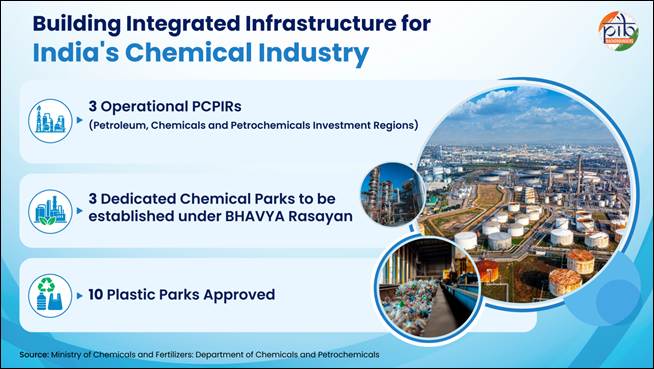
- PCPIRs: three Petroleum, Chemicals and Petrochemicals Investment Regions operate, at Dahej (Gujarat), Visakhapatnam–Kakinada (Andhra Pradesh) and Paradeep (Odisha). They have drawn ₹3.4 lakh crore, created 3.7 lakh jobs and helped set up over 2,200 units.
- BHAVYA Rasayan: approved in July 2026 with an outlay of ₹3,030 crore, it will build three chemical parks of at least 8 sq km each, with up to ₹1,000 crore per park from the Centre if the state puts in at least ₹500 crore. It runs from 2026-27 to 2030-31.
- Plastic Parks: ten are approved; four have completed their infrastructure, three of them in 2025-26. The Centre funds up to 50% of project cost, capped at ₹40 crore.
Research and skills
The ₹1 lakh crore Research, Development and Innovation Scheme, launched in November 2025, added advanced chemicals, petrochemicals and material technologies as an eligible area from 8 October 2026.
CIPET now has 51 centres, 19 of them set up since 2014, and has trained nearly 6.72 lakh people. Its 18 Centres of Excellence have filed 85 patents and developed 105 new technologies and products.
Quality and safety
As of August 2026, 37 Quality Control Orders make specified standards mandatory. A training programme for Major Accident Hazard units aims to reach all 2,393 units over five years; by August, 21 programmes had trained 2,441 people from 1,376 units.
The 14th India Chem 2026 was held in Mumbai from 22 to 24 October, with more than 5,000 visitors.
Photos
Source: official release by the PIB Backgrounder, issued through the Press Information Bureau, Government of India (07 NOV 2026 10:47AM by PIB Delhi). Read the full official text: India’s Chemicals and Petrochemicals Sector: A Foundation for Industrial Growth.
How we verified this
VerifiedEvery fact, figure and quotation is taken from the official PIB release (Release ID 2333894) issued by the PIB Backgrounder on 07 NOV 2026 10:47AM by PIB Delhi; checked against the source on publication. Story written by BDT from that release; no outside facts added.
Sources
- 1.India’s Chemicals and Petrochemicals Sector: A Foundation for Industrial Growth — Press Information Bureau, Government of India