ExplainersExplainerVerified
How India plans to process its own lithium and nickel under a ₹2,814-crore scheme
A 30% capital subsidy will back four plants, chosen through a two-stage competitive process, with money released against milestones.
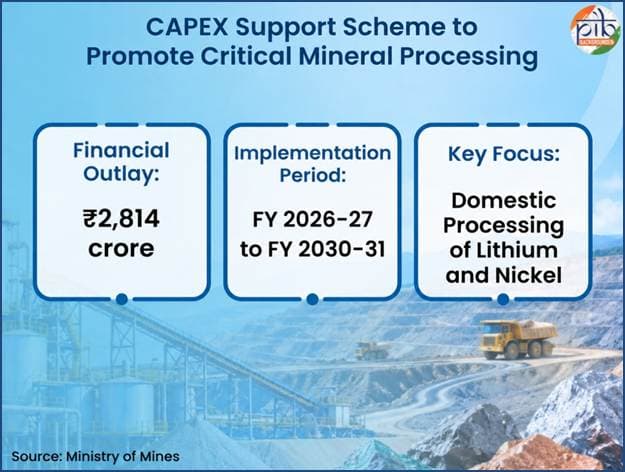
India will pay 30 per cent of the capital cost of four lithium and nickel processing plants, a bid to cut its reliance on imported refined minerals. The CAPEX Support Scheme to Promote Critical Mineral Processing, approved by the Union Cabinet on 4 November 2026, has an outlay of ₹2,814 crore.
The scheme runs for five years, from FY 2026-27 to FY 2030-31, and offers a 30 per cent capital subsidy on eligible investment. It is expected to attract about ₹10,000 crore of processing investment, according to the PIB backgrounder.
Why the gap matters
India has identified 24 critical minerals, including lithium, nickel, cobalt, graphite and rare earth elements. The backgrounder says the country's needs for refined intermediates and high-purity materials are "met largely through imports", and that processing worldwide is concentrated in a few countries, which exposes supply chains to disruption, price swings and export restrictions.
It adds that domestic processing is not currently viable under market conditions: plants need advanced equipment, multi-stage conversion and strict environmental safeguards, which raise capital costs, while raw material and technology access is limited.
What will be built
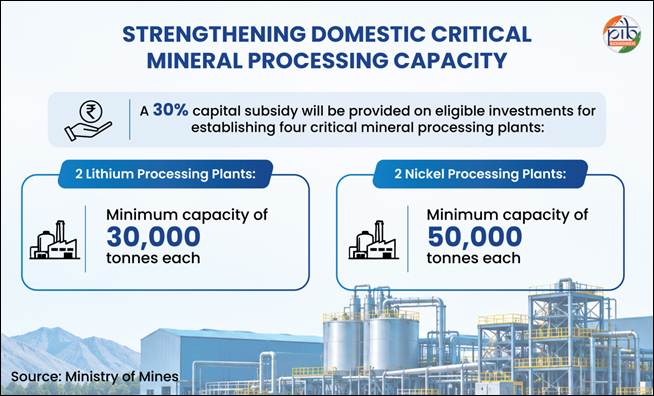
The subsidy will support four plants:
- Two lithium plants of at least 30 kt capacity each, processing ores and concentrates (not brines) into battery-grade products.
- Two nickel plants of at least 50 kt capacity each, producing Class-1 nickel or battery-grade nickel sulphate, with cobalt recovery.
Support is capped at ₹500 crore per lithium beneficiary and ₹900 crore per nickel beneficiary, which comes to ₹1,000 crore and ₹1,800 crore, a total of ₹2,800 crore. A further ₹14 crore, 0.5 per cent of the outlay, covers administrative costs. The scheme is fully funded from the Union Budget.
How companies are chosen and paid
Selection has two stages. First, applications are assessed on technical criteria. Then qualified applicants submit financial bids, and the lowest CAPEX support sought wins. Two beneficiaries will be picked for each mineral.
Money is released in three tranches linked to milestones:
| Tranche | Milestone | Cumulative subsidy released |
|---|---|---|
| 1 | 25% of committed CAPEX spent, with at least 15% of minimum required equity contributed | 25% |
| 2 | 50% of committed CAPEX spent, with at least 50% of minimum required equity contributed | 50% |
| 3 | Plant commissioned, with 100% of minimum required equity contributed | 100% |
Plants must be commissioned within three years of the Letter of Award and in any case within five years. If commissioning slips beyond three years, the undisbursed support will taper until the fifth year.
A Governing Council chaired by the Secretary, Ministry of Mines, will make the final selection, advised by a Techno-Financial Committee. A Project Management Agency will handle implementation.
What it is expected to deliver
The scheme is expected to support 60 kt of lithium and 100 kt of nickel processing capacity to meet projected demand by 2030. The government also expects lower import bills, more downstream battery material, battery cell and speciality steel manufacturing, and direct and indirect jobs.
It sits alongside the National Critical Mineral Mission, launched in January 2025, which includes a ₹1,500-crore recycling scheme approved on 3 September 2025. So far, 64 critical and strategic mineral blocks and 11 Exploration Licence blocks have been auctioned.
Photos
Source: official release by the PIB Backgrounder, issued through the Press Information Bureau, Government of India (05 NOV 2026 1:56PM by PIB Delhi). Read the full official text: CAPEX Support Scheme to Promote Critical Mineral Processing.
How we verified this
VerifiedEvery fact, figure and quotation is taken from the official PIB release (Release ID 2332964) issued by the PIB Backgrounder on 05 NOV 2026 1:56PM by PIB Delhi; checked against the source on publication. Story written by BDT from that release; no outside facts added.
Sources
- 1.CAPEX Support Scheme to Promote Critical Mineral Processing — Press Information Bureau, Government of India