ExplainersExplainerVerified
From one Delhi experiment to 35 Doordarshan channels: how India’s television changed
A PIB backgrounder for World Television Day traces terrestrial, satellite, cable, DTH and internet broadcasting.
India's television story began with a small experimental broadcast in Delhi on 15 September 1959 and has grown into a multi-platform system that includes 35 Doordarshan channels, DD Free Dish and internet streaming, according to a PIB backgrounder issued ahead of World Television Day on 21 November.
The United Nations General Assembly proclaimed 21 November as World Television Day in 1996, to recognise television's role in informing, educating and connecting societies.
From terrestrial to satellite
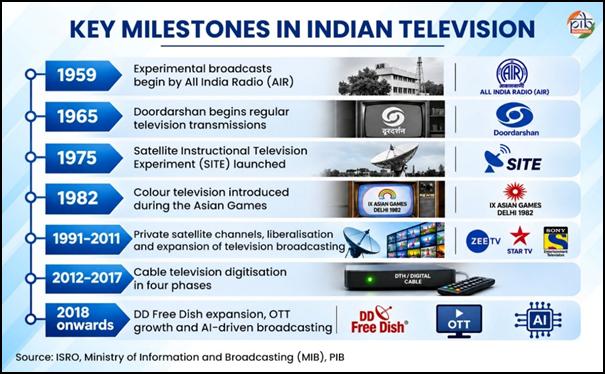
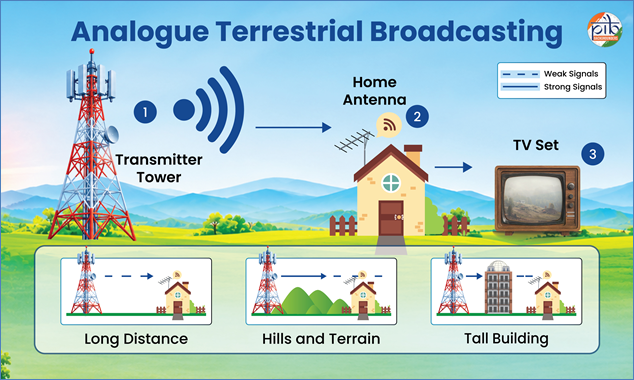
The 1959 experiment was launched by All India Radio. Regular service began in 1965, and Doordarshan started a daily Hindi news bulletin on 15 August 1965. On 1 April 1976 it became a separate department of the Information and Broadcasting Ministry. By then the terrestrial network had eight stations covering 45 million people across 75,000 square kilometres.
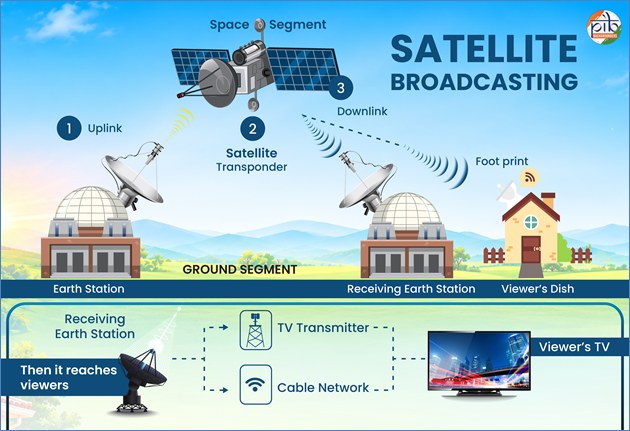
The Satellite Instructional Television Experiment (August 1975 to July 1976) beamed educational programmes to villages in six States. INSAT-1B, launched in August 1983, strengthened the national network. Doordarshan's first colour telecast took place on 15 August 1982, and the Asian Games in New Delhi that November brought colour to wider audiences.
Cable, DTH and digital
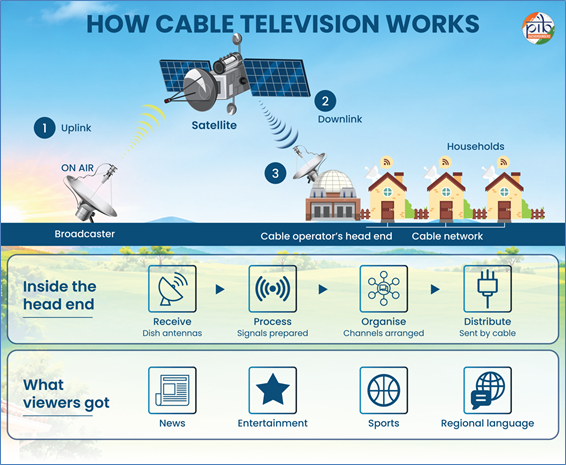
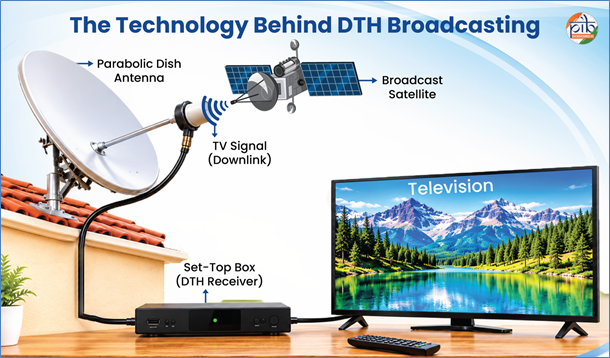
Private satellite channels arrived in the early 1990s, and cable networks spread from the mid-1990s. Dish TV launched India's first commercial Direct-to-Home (DTH) service in October 2003. In December 2004 Prasar Bharati launched DD Direct Plus, now DD Free Dish, a free-to-air platform with no monthly subscription.
Today
Since 2018, smartphones, smart TVs and over-the-top (OTT) platforms have changed viewing. Prasar Bharati launched its OTT platform WAVES in November 2024, which had about 1.6 crore registered users by November 2026.
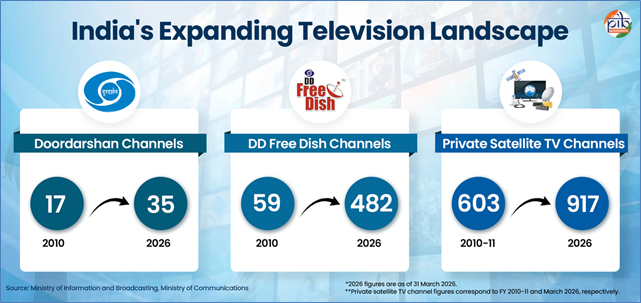
- Doordarshan runs 35 channels, up from 17 in 2010.
- DD Free Dish carries 482 channels, up from 59.
- Private satellite channels: 917 permitted as of March 2026, of which 908 were available for downlinking in India (342 pay and 566 free-to-air).
- Private pay DTH had 49.05 million active subscribers on 31 March 2026.
The backgrounder also describes Direct-to-Mobile (D2M) broadcasting, which needs no SIM card or mobile data, and says Prasar Bharati published test results in November 2025.
Photos
Source: official release by the PIB Backgrounder, issued through the Press Information Bureau, Government of India (20 NOV 2026 12:01PM by PIB Delhi). Read the full official text: India’s Television Broadcasting Shift.
How we verified this
VerifiedEvery fact, figure and quotation is taken from the official PIB release (Release ID 2338893) issued by the PIB Backgrounder on 20 NOV 2026 12:01PM by PIB Delhi; checked against the source on publication. Story written by BDT from that release; no outside facts added.
Sources
- 1.India’s Television Broadcasting Shift — Press Information Bureau, Government of India