ExplainersExplainerVerified
Explained: how Gujarat rebuilt 1.87 lakh homes after the 2001 Kutch earthquake
A government backgrounder traces the recovery, from ₹500 crore sanctioned on the first day to families rebuilding their own houses.
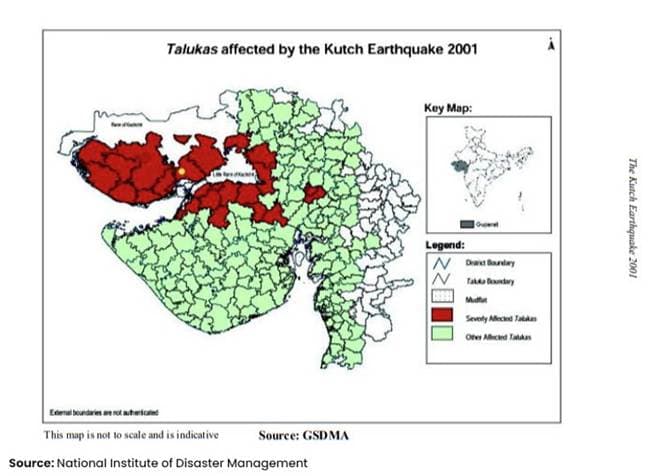
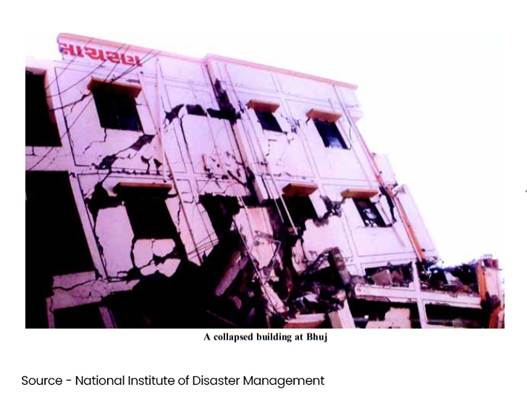
At 8:46 a.m. on 26 January 2001, an earthquake of magnitude 6.9 struck Gujarat, with its epicentre in Kutch. It killed 13,805 people, 12,221 of them in Kutch, and destroyed more than two lakh homes. A government backgrounder released on 16 November traces how the state rebuilt.
The earthquake affected about 7,633 villages in 181 talukas and nearly one crore people. About 1.67 lakh people were injured and about nine lakh houses were damaged. More than 10,000 small and medium industrial units stopped production and about 50,000 artisans lost their livelihoods. Gujarat had emergency plans for cyclones and floods, but none for earthquakes, the backgrounder says.
The first hours
Landline and mobile networks around Gandhinagar failed within an hour, leaving satellite phones and police wireless as the main links. In Bhuj, the police chief led search and rescue and the Collector ran relief. A medical camp was set up within about two hours, an Army platoon was deployed and police families started a community kitchen.
The National Crisis Management Committee met under the Prime Minister the same day, and ₹500 crore was sanctioned for immediate relief.
A new authority
On 8 February 2001, Gujarat set up the Gujarat State Disaster Management Authority (GSDMA), modelled on the body Orissa created after the 1999 super cyclone. Its governing body was chaired by the Chief Minister, and its framework gave Village Committees and Gram Sabhas a say in relocating badly damaged villages.
The World Bank and the Asian Development Bank put the damage at ₹9,909 crore and reconstruction at about ₹10,575 crore. The state later estimated the cost at about ₹8,496 crore and met about 30%, roughly ₹2,603 crore, from its own funds.
Families rebuilt their own homes
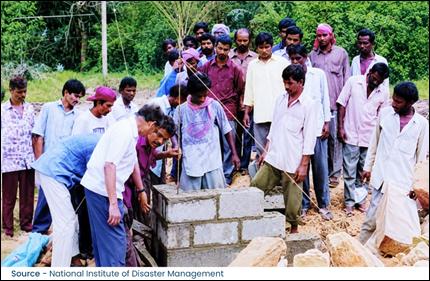
Under an owner-driven approach, families rebuilt their houses themselves with government money, technical guidance and safe designs, instead of using contractors. Payments came in instalments after an engineer certified each stage.
- 1,082 material banks supplied cement and other materials
- nearly 30,000 masons and 6,200 engineers were trained
- about 2.6 lakh houses were inspected independently
- rebuilt houses were registered jointly in the names of husband and wife
District Judges served as ombudsmen. By October 2003 they had received 47,156 petitions and dealt with about 99% of them.
Course correction
A review in October 2001 found families still in tents, offices and schools in temporary buildings, and urban rebuilding lagging behind villages. Disciplinary action was taken against 276 government employees in connection with debris clearance, and cases were started against 738 people linked to local bodies.
Narendra Modi became Chief Minister that month. After a fresh review, 11 senior Secretaries were assigned to the worst-hit talukas, spending three days there every weekend until January 2002 and reporting at weekly Monday meetings.
Progress by 2004
| Measure | Figure |
|---|---|
| Houses repaired by January 2002 | about 7.7 lakh |
| Houses rebuilt by January 2004 | about 1.87 lakh (87% of a 2.15 lakh target) |
| Schoolrooms repaired | all 42,678 identified |
| Destroyed schoolrooms rebuilt | 7,469 of 8,212 |
| New industrial projects in Kutch by March 2004 | 151, proposed investment about ₹4,785 crore |
A new ₹114-crore district hospital in Bhuj, built with earthquake-resistant base isolation technology, opened on 14 January 2004.
What it left behind
Gujarat adopted a State Disaster Management Policy in 2002 and passed the Gujarat State Disaster Management Act in 2003. Preparedness teams were formed in 484 villages. The work won the United Nations Sasakawa Award in 2003, and these steps came before the national Disaster Management Act, 2005.
Photos
Source: official release by the PIB Backgrounder, issued through the Press Information Bureau, Government of India (16 NOV 2026 11:34AM by PIB Delhi). Read the full official text: Kutch Earthquake 2001.
How we verified this
VerifiedEvery fact, figure and quotation is taken from the official PIB release (Release ID 2336752) issued by the PIB Backgrounder on 16 NOV 2026 11:34AM by PIB Delhi; checked against the source on publication. Story written by BDT from that release; no outside facts added.
Sources
- 1.Kutch Earthquake 2001 — Press Information Bureau, Government of India