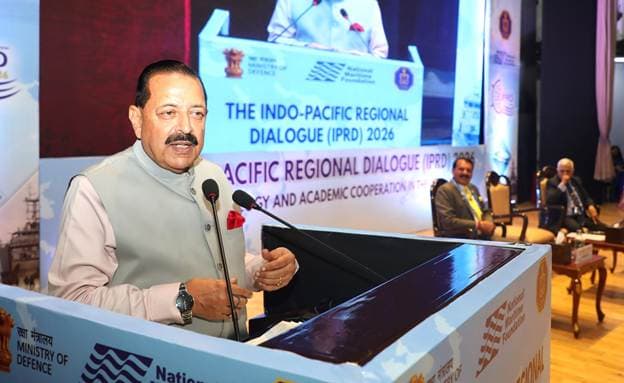
India is working towards its first human deep-sea mission, to a depth of up to 6,000 metres, by 2028, Science and Technology and Earth Sciences Minister of State (Independent Charge) Jitendra Singh said at the Indo-Pacific Regional Dialogue (IPRD) 2026.
The dialogue was organised by the National Maritime Foundation under the Ministry of Defence. Singh said India aims for global competitiveness in ocean research "through indigenous capabilities, international cooperation and global co-creation".
Deep-ocean capability
- The National Institute of Ocean Technology (NIOT), Chennai, can now conduct trials at depths of 5,000 to 6,000 metres in the Central Indian Ocean Basin, he said.
- The Ocean Mineral Explorer allows high-resolution exploration of hydrothermal sulphide deposits, several of which have been identified.
- Under the Samudrayaan Mission, the Matsya submersible is designed to carry three aquanauts to 5,000–6,000 metres.
Singh also spoke of a "convergence of deep-sea and space exploration", with one Indian making a deep-sea journey while another travels into space.
One approach across ministries
He said India's scientific missions now work in a mission mode across departments, combining ocean science, space, nuclear science, geology, electronics and robotics. He noted dedicated satellites that observe ocean colour, sea-surface temperature and wind, and nuclear-supported desalination at Kalpakkam and a low-temperature facility in Lakshadweep.
Because oceans "do not follow political boundaries", he called for joint scientific missions, reciprocal access to research facilities and data sharing.
Photos
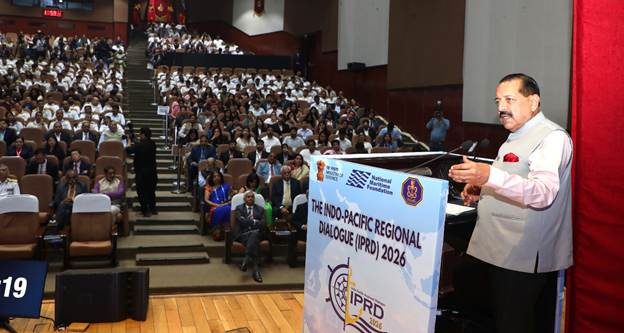
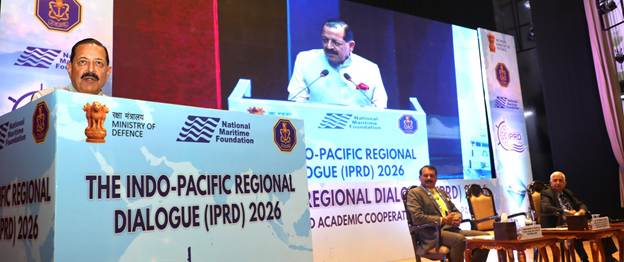
Source: official release by the Ministry of Earth Sciences, issued through the Press Information Bureau, Government of India (04 NOV 2026 5:31PM by PIB Delhi). Read the full official text: India Aiming for Global Competitiveness Through Indigenous Capabilities and International Cooperation: Dr. Jitendra Singh at IPRD 2026.
How we verified this
VerifiedEvery fact, figure and quotation is taken from the official PIB release (Release ID 2332636) issued by the Ministry of Earth Sciences on 04 NOV 2026 5:31PM by PIB Delhi; checked against the source on publication. Story written by BDT from that release; no outside facts added.
Sources
- 1.India Aiming for Global Competitiveness Through Indigenous Capabilities and International Cooperation: Dr. Jitendra Singh at IPRD 2026 — Press Information Bureau, Government of India