ExplainersExplainerVerified
India’s renewable push in numbers: 308 GW non-fossil capacity and 175 GW of solar
A PIB backgrounder on solar, wind, bio-energy, green hydrogen and geothermal, with the latest official figures.
India's installed power capacity is around 560 GW as of October 2026, up from 249 GW in 2014, and non-fossil sources account for 308 GW of it, according to a Press Information Bureau backgrounder on the renewable energy sector.
The 308 GW figure, as of 31 July 2026, is 55% of total installed capacity. The backgrounder says India ranks third globally in installed renewable capacity and attracted USD 63.7 billion of investment in its renewable sector between July 2024 and June 2026.
Solar
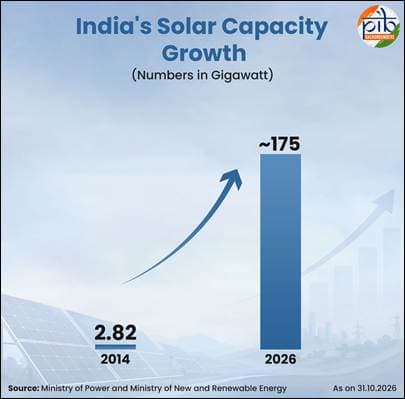
Installed solar capacity has reached about 175 GW as of 31 October 2026, from 2.8 GW in 2014, making solar the largest part of the renewable mix. India became the world's second-largest solar growth market in 2025, adding more than 37 GW against 34 GW added by the United States.
Under PM-Surya Ghar: Muft Bijli Yojana, launched in February 2024 with an outlay of ₹75,021 crore for 1 crore households:
- 65.26 lakh households now have rooftop solar (as of 2 November 2026).
- About ₹35,800 crore in subsidy has been transferred.
- Nearly 21 lakh households have had zero electricity bills until October 2026.
- 19.1 GW of rooftop capacity has been commissioned.
The Pradhan Mantri Surya Sarovar Yojana, approved on 31 July 2026 with ₹5,070 crore, targets 5,000 MW of floating solar projects with storage of at least two hours, or 10,000 MWh, sanctioned between FY 2026–27 and FY 2030–31.
Wind
India ranks fourth globally, with 59.20 GW installed as of 29 October 2026. It added 6.05 GW in FY 2025–26, its highest-ever annual addition and 46% above the year before, and about 28 GW more is under implementation. Turbine manufacturing capacity is about 24 GW, up from 10 GW in 2014, with 70–80% indigenisation across key components.
Bio-energy and geothermal
Bio-power capacity is 11.75 GW as of 29 October 2026. Of 839 compressed biogas plants registered as of 2 November, 210 are commissioned and 255 under construction. The GOBARdhan National Circular Bioenergy Scheme, approved on 6 August 2026 with ₹23,731 crore for FY 2026–27 to FY 2035–36, aims to expand domestic compressed biogas production.
The National Policy on Geothermal Energy, notified on 15 September 2025, builds on a Geological Survey of India estimate of about 10,600 MW of potential based on 381 hot springs. Five projects were sanctioned in July–August 2025.
Green hydrogen
About 8,000 tonnes a year of green hydrogen capacity had been commissioned by February 2026. In July 2026 the government launched 12 pilot projects for 70 hydrogen-powered vehicles across 21 routes, and India's first indigenous hydrogen fuel-cell train began operating on the Jind–Sonipat section.
Bharat Renewable Energy Summit
The Bharat Renewable Energy Summit & Expo was held in New Delhi from 2 to 5 November 2026, with nine country partners, 13 states and Union Territories, and more than 400 exhibitors.
Source: official release by the PIB Backgrounder, issued through the Press Information Bureau, Government of India (13 NOV 2026 1:02PM by PIB Delhi). Read the full official text: India’s Renewable Energy Journey: Powering a Cleaner Future.
How we verified this
VerifiedEvery fact, figure and quotation is taken from the official PIB release (Release ID 2335742) issued by the PIB Backgrounder on 13 NOV 2026 1:02PM by PIB Delhi; checked against the source on publication. Story written by BDT from that release; no outside facts added.
Sources
- 1.India’s Renewable Energy Journey: Powering a Cleaner Future — Press Information Bureau, Government of India