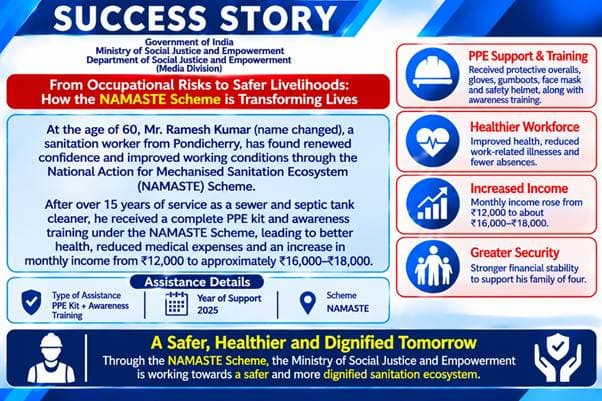
A 60-year-old sewer and septic tank cleaner in Pondicherry says protective equipment and safety training under the NAMASTE scheme improved his health and raised his income, according to a case study from the Social Justice Ministry. The name used, Ramesh Kumar, has been changed.
A Scheduled Caste worker with the Pondicherry Municipality for more than 15 years, he had worked for years without adequate protective gear. He had recurring skin infections and breathing discomfort, which affected his work and raised his medical costs. He studied up to Class 5 and is the only earner in a family of four.
What changed
In 2025 he received a full personal protective equipment kit under the National Action for Mechanised Sanitation Ecosystem (NAMASTE) scheme: overalls, heavy-duty gloves, gumboots, a face mask and a safety helmet. He also had training on safe sanitation practice and preventing occupational health risks.
The ministry says his health improved considerably, absences from work and medical costs fell, and his monthly income rose from about ₹12,000 to around ₹16,000-₹18,000.
This is one worker's account as presented by the ministry; it is not data on the scheme's overall results.
Source: official release by the Ministry of Social Justice & Empowerment, issued through the Press Information Bureau, Government of India (06 NOV 2026 8:50PM by PIB Delhi). Read the full official text: From Occupational Risks to Safer Livelihoods.
How we verified this
VerifiedEvery fact, figure and quotation is taken from the official PIB release (Release ID 2333803) issued by the Ministry of Social Justice & Empowerment on 06 NOV 2026 8:50PM by PIB Delhi; checked against the source on publication. Story written by BDT from that release; no outside facts added.
Sources
- 1.From Occupational Risks to Safer Livelihoods — Press Information Bureau, Government of India