India has issued its first guidelines for officially recognising conservation areas that lie outside forests and protected areas, such as sacred groves, community-managed tanks and seagrass beds.
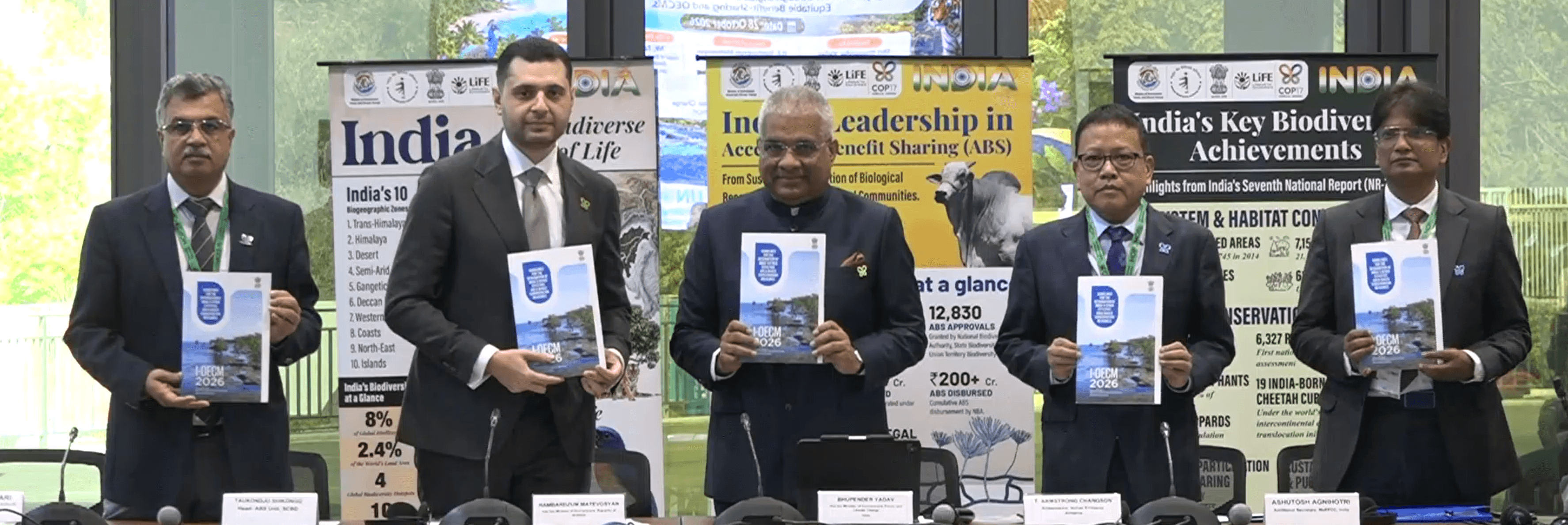
Environment Minister Bhupender Yadav released the "Guidelines for the designation of India's Other Effective Area-Based Conservation Measures (I-OECMs) 2026" on 3 November at a side event of the 17th Conference of the Parties to the Convention on Biological Diversity (CBD COP-17) in Yerevan, Armenia. Armenia's environment minister and the CBD's Executive Secretary joined the release.
What counts as an I-OECM
The guidelines were prepared by the Environment Ministry with the National Biodiversity Authority (NBA). They cover land, inland water, and coastal and marine ecosystems. Examples include biodiversity parks, sacred groves, community-managed irrigation tanks, seagrass and seaweed beds, and fisheries seasonal ban areas.
Four criteria are mandatory. The area must not already be legally protected or conserved. It must be governed under Central or State frameworks or by recognised local bodies such as Panchayats and Biodiversity Management Committees. It must have defined boundaries and not overlap with areas already reported to the World Database on Protected Areas. And recognition must not change the area's existing activities, governance or rules.
Recognition does not make an area a protected area and does not change its ownership or legal status.
How a site gets recognised
Government departments, local self-governments and Biodiversity Management Committees can apply to the NBA. The NBA forwards each application to the state biodiversity board within 30 days, and the board sends its recommendation back within 30 days. The NBA decides with an inter-departmental committee, and the ministry authorises recognition. Each site needs a monitoring framework reviewed at least every five years.
The funded project
A separate GEF-8 project will put the guidelines to work in six landscapes, including Gori Valley in Uttarakhand and the Kumbhalgarh-Mount Abu-Jaisalmer landscape in Rajasthan. It runs from 15 May 2026 to 15 May 2032 with total financing of USD 60.79 million: a GEF grant of USD 6.65 million and confirmed co-financing of USD 54.14 million. It aims to add 3 per cent of India's land and marine area to the conservation estate, on top of the 27 per cent already protected.
Source: official release by the Ministry of Environment, Forest and Climate Change, issued through the Press Information Bureau, Government of India (04 NOV 2026 7:15PM by PIB Chennai). Read the full official text: Union Environment Minister Shri Bhupender Yadav releases Guidelines for Designation of India’s Other Effective Area-Based Conservation Measures (I-OECMs), 2026, at CBD COP-17 in Yerevan, Armenia.
How we verified this
VerifiedEvery fact, figure and quotation is taken from the official PIB release (Release ID 2332733) issued by the Ministry of Environment, Forest and Climate Change on 04 NOV 2026 7:15PM by PIB Chennai; checked against the source on publication. Story written by BDT from that release; no outside facts added.
Sources
- 1.Union Environment Minister Shri Bhupender Yadav releases Guidelines for Designation of India’s Other Effective Area-Based Conservation Measures (I-OECMs), 2026, — Press Information Bureau, Government of India