India vs WorldVerified
Indian-built silicon chip carries 100 Gbit/s terahertz signals past barriers, a step towards 6G
JNCASR researchers report only 1–2% loss from a single barrier, against a marked drop in a conventional waveguide.
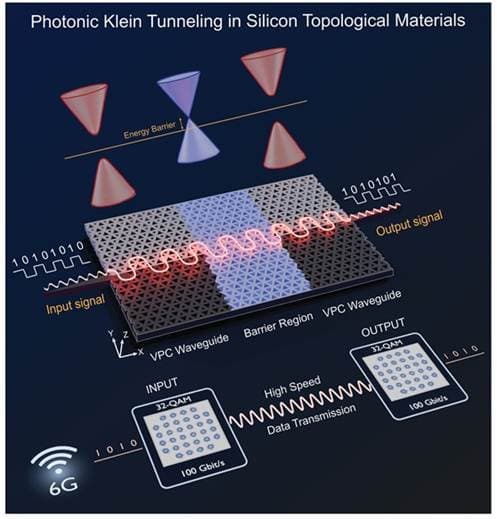
Researchers at the Jawaharlal Nehru Centre for Advanced Scientific Research (JNCASR) have built a silicon chip that carries terahertz signals past engineered obstacles with little loss, and sent data through it at up to 100 gigabits per second (Gbit/s), a step towards compact circuits for future 6G networks.
Sixth-generation networks are expected to use terahertz frequencies, which offer wide bandwidth. But bends, junctions and sudden changes in a waveguide scatter or reflect part of the signal, weakening it.
What the team did
The chip is a silicon photonic crystal, a slab with triangular holes in a pattern that mimics the honeycomb lattice of graphene. It guides terahertz waves along the boundary between two regions. The team created a barrier by changing the sizes of the holes over a short stretch.
A single barrier added only about 1–2% loss, and two barriers in sequence about 2–3%. In a conventional waveguide, the release says, a comparable barrier "markedly reduces transmission". The team says transmission stayed close to its barrier-free level while the barrier strength stayed below a characteristic coupling strength of the crystal, which gives a design rule.
The tests
Three devices were made on high-resistivity silicon, a material compatible with established semiconductor manufacturing, and tested across 310–360 GHz. Measurements agreed closely with simulations.
- Double-barrier device: 48 Gbit/s.
- Omega-shaped route with four sharp bends and a barrier: 60 Gbit/s.
- Power splitter with a barrier in one branch: 100 Gbit/s using QAM-32 modulation.
At 100 Gbit/s, the release says, a 5-gigabyte high-definition film could in principle be transferred in under half a second.
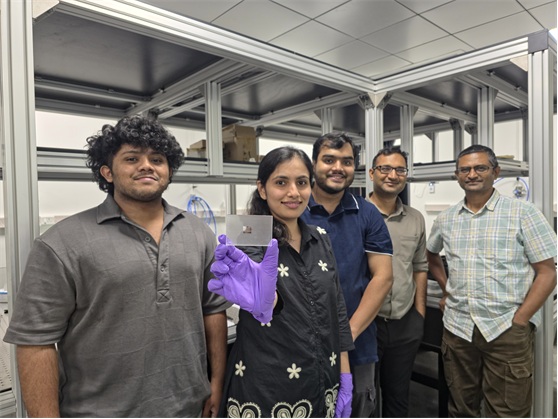
The study was led by Dr Abhishek Kumar of JNCASR, an autonomous institute of the Department of Science and Technology. The release describes laboratory demonstrations only and gives no timeline for 6G use.
Photos
Source: official release by the Ministry of Science & Technology, issued through the Press Information Bureau, Government of India (04 NOV 2026 5:22PM by PIB Delhi). Read the full official text: Novel silicon chip allowing terahertz waves to pass through barriers could enable future 6G networks.
How we verified this
VerifiedEvery fact, figure and quotation is taken from the official PIB release (Release ID 2332613) issued by the Ministry of Science & Technology on 04 NOV 2026 5:22PM by PIB Delhi; checked against the source on publication. Story written by BDT from that release; no outside facts added.
Sources
- 1.Novel silicon chip allowing terahertz waves to pass through barriers could enable future 6G networks — Press Information Bureau, Government of India