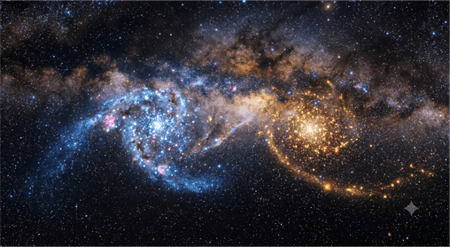
Indian astronomers have found that a star group long catalogued as a single cluster, UBC 63, is in fact two separate clusters that recently passed close to each other.
UBC 63 is a loosely bound open cluster about 4,892 light years from Earth. Earlier studies had little data on it and assumed it was one cluster. A team led by researchers from India, including a DST INSPIRE fellow, Gauhati University and the Indian Institute of Astrophysics, used data from the European Space Agency's Gaia mission to study star formation inside it and found, in their words, a surprise: two clusters, UBC 63A and UBC 63B.
What they found
Gaia's precise measurements of star positions and motions showed that the two clusters are of very different ages. Member stars formed two distinct sequences in the colour–magnitude diagram, a key tool for judging a cluster's evolutionary stage.
Why it matters
Encounters between clusters are relatively uncommon. Spotting a system soon after such a flyby offers clues about how gravitational interactions shape cluster structure, motion and long-term evolution in the Milky Way.
The release describes the discovery as a chance finding. It does not give the ages of the two clusters.
Source: official release by the Ministry of Science & Technology, issued through the Press Information Bureau, Government of India (05 NOV 2026 5:38PM by PIB Delhi). Read the full official text: Team led by Indian astronomers redefine star cluster UBC 63 as a double cluster system spotted after close flyby.
How we verified this
VerifiedEvery fact, figure and quotation is taken from the official PIB release (Release ID 2333191) issued by the Ministry of Science & Technology on 05 NOV 2026 5:38PM by PIB Delhi; checked against the source on publication. Story written by BDT from that release; no outside facts added.
Sources
- 1.Team led by Indian astronomers redefine star cluster UBC 63 as a double cluster system spotted after close flyby — Press Information Bureau, Government of India